

Ten years on, my white-knuckle AWS journey looks uncannily like every AI conversation I’m having now. Same fears, same breakthroughs — and the same uncomfortable truth about who actually adapts.
I’ve been having the same conversation on repeat for eighteen months. Someone senior — usually very senior — leans in during a coffee break and says, “This AI thing. Where do we even start?” The tone is identical every time: half curiosity, half dread, 100% exhaustion at the thought of another seismic shift they’re supposed to master by Thursday.
It’s been nagging at me because I’ve felt that exact cocktail before. It took listening back to this week’s podcast episode — a slightly self-indulgent trip through my 2015 AWS deep-dive — to realise why. The parallels between broadcast’s cloud panic and today’s AI reckoning aren’t just superficial. They’re structural. And if we’re honest about what actually happened back then, we might save ourselves some pain now.
The Bit Where Everyone Said It Wouldn’t Work
Early 2015: the broadcast industry was convinced cloud was a non-starter. I was embedded in a major cloud migration project, surrounded by brilliant engineers who’d spent decades perfecting on-premise workflows. The default posture was scepticism bordering on hostility.
At a January webinar — Cloud Reality, fittingly — a representative from a major broadcaster admitted their entire mental model was “infrastructure-as-a-service.” Servers in someone else’s data centre. That’s it. The idea of fundamentally rethinking workflows? Not on the agenda. They needed software refactoring just to make legacy systems fit, and vendors weren’t helping — most were just tweaking on-prem products with “cloud-ready” stickers.
Sky were even blunter. Past AWS outages — ones that had taken down Amazon’s own retail site and Netflix — were proof you couldn’t trust it for live broadcast. Fair point, actually. When you’re delivering 152 petabytes per year and a single dropout costs you millions in ad revenue and audience trust, “trust us, it’s mostly fine” doesn’t cut it.
And then there were the basics that simply didn’t exist yet. GPUs — essential for any serious media workflow — weren’t a standard cloud offering. Broadcasters had to educate AWS about needing higher-tier graphics processing. It was a mutual learning curve, except one side was risking their entire operation on the other’s ability to catch up.
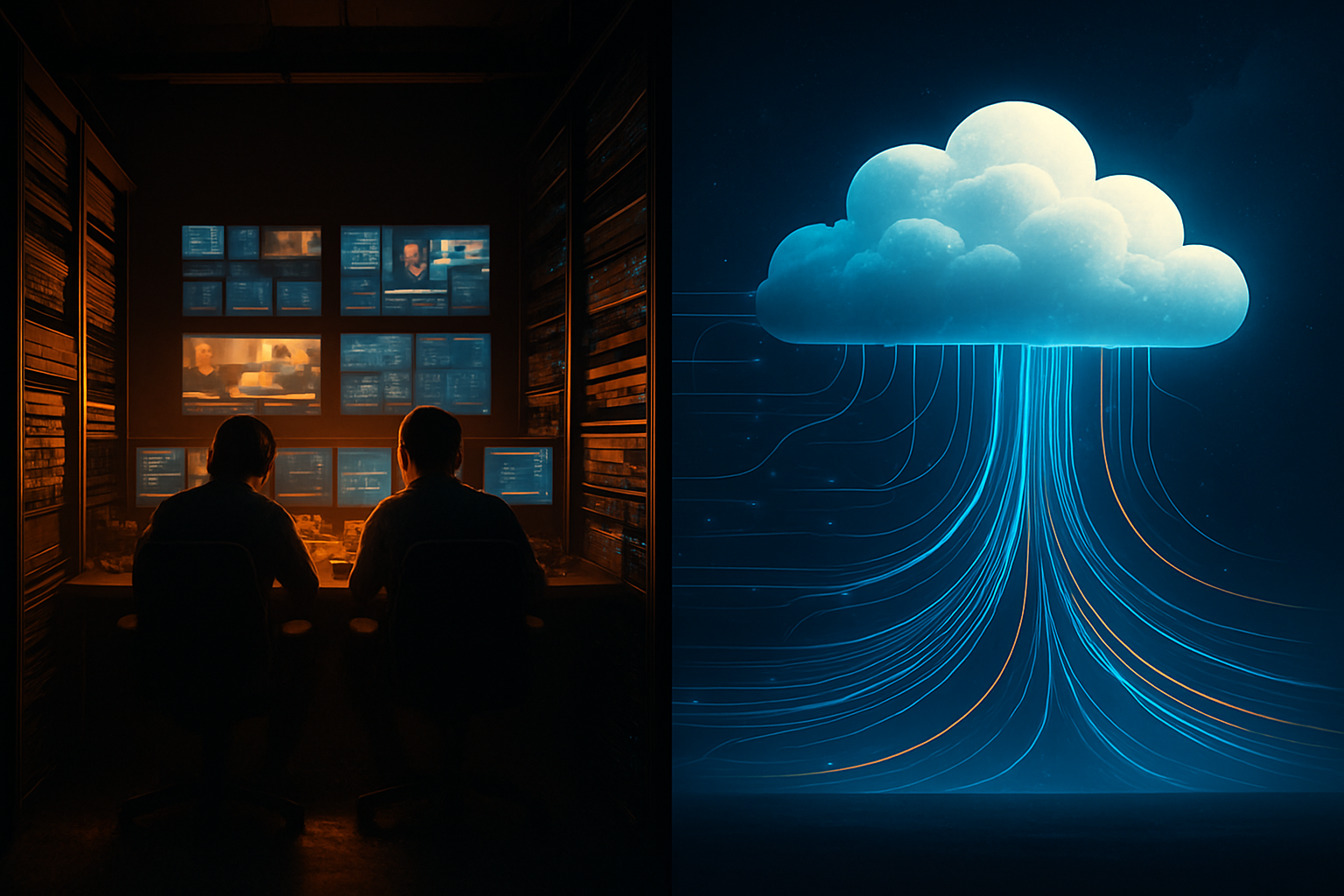
But here’s what happened next, and it happened fast. By mid-2015, that same broadcaster who’d been fixated on IaaS admitted video processing and delivery were “100% there” in the cloud. Two years earlier, they wouldn’t have touched it. Now they were advising others to be “first or second customers” with vendors so they could shape product development. Land and expand.
Discovery was hiring for playout migration — moving core channel operations. AMC was exploring private cloud for the same. At an October CDN conference, I saw CloudCoder demoing live TV delivery using standard web tech, with Eurosport already onboard. A guy from Tribe was live-mixing from smartphone streams via AWS and remote desktop. From a smartphone. In 2015.
The tipping point wasn’t some single breakthrough. It was dozens of small ones, compounding weekly, until the people who’d said “never” six months prior were suddenly designing their entire future operations around cloud.
The Bit Where I Became Insufferable
I got obsessed. Properly, obnoxiously obsessed. It started at an AWS re:Invent workshop in October. A technical evangelist said something that stuck: “Don’t forget what you know. Just apply it for the cloud.”
Simple, right? But it reframed everything. This wasn’t about abandoning broadcast expertise; it was about translating it into a new grammar. So I went all-in. Booked every workshop AWS offered — half-day, full-day, didn’t matter. Registered for the Solutions Architect Associate exam (£150, which felt like a lot). Bought practice tests. Subscribed to Qwiklabs for hands-on exercises. Used Lucidchart for architecture diagrams because it had AWS templates baked in.
I pestered AWS ProServe engineers, badgered the head of Broadcast Solution Architects for real-world diagrams, and built a learning ecosystem that probably looked unhinged from the outside. But the alternative was being left behind, and that felt worse.
The learning curve was vertical. Security alone nearly broke me. The shared responsibility model — AWS secures the cloud, you secure in the cloud — sounds obvious now, but back then it was a conceptual minefield. Who holds the encryption keys? What happens if you leave access credentials on GitHub? (Spoiler: someone spins up a thousand servers on your account, and you get a five-figure bill.)
Cost management was equally brutal. I learned about reserved instances, cron jobs to shut down EC2 overnight, regional pricing differences. And then there was the cautionary tale: a DDoS attack that cost one project $15,000 because AWS auto-scaled to handle 86 million connections over four days. The cloud giveth, and the cloud taketh away — with frightening efficiency.

But the deeper I went — compute, storage, networking, databases, Lambda’s early serverless promise, infrastructure-as-code with CloudFormation — the more I realised this wasn’t just about technology. It was about mindset. Moving from “this is how we’ve always done it” to “what’s actually possible now?” That shift, not the tech itself, was the revolution.
The Bit Where I Connect the Dots (and You See It Coming)
So why dredge all this up now? Because every conversation I’m having about AI in 2025 has the same shape as those cloud conversations in 2015.
The initial resistance: “Our workflows are too complex.” The trust deficit: “What if it hallucinates something career-ending?” The missing basics: “We don’t have the infrastructure.” The mutual learning curve: “The vendors don’t understand broadcast.”
And beneath it all, the same exhausted question: “Where do we even start?”
Here’s what I learned from 2015 that applies directly to AI today:
The tipping point comes faster than you think. Twelve months separated “we’ll never trust cloud” from “we’re all-in.” AI adoption is tracking the same curve, just faster.
Early adopters shape the tools. Those broadcasters who engaged early with AWS influenced product roadmaps. Same’s true now with AI — if you’re not in the room, someone else is designing your future.
Expertise doesn’t transfer automatically. I knew broadcast. That didn’t make me good at AWS until I committed to learning AWS on its own terms. Same with AI. Your domain knowledge is essential, but it’s not sufficient.
The real shift is cultural, not technical. Cloud didn’t just replace servers; it changed how we thought about infrastructure, resilience, and scale. AI won’t just automate tasks; it’ll redefine what we consider creative work, editorial judgment, and audience relationship.
You can’t outsource the learning. I could’ve waited for someone else to figure out AWS. But the people who thrived were the ones who got hands dirty early, made mistakes in safe environments, and built deep understanding. That’s the game now with AI.
And here’s the uncomfortable bit: the broadcasters who hesitated in 2015, waiting for “proof” and “maturity,” didn’t get left behind overnight. They got left behind gradually, then suddenly, as competitors who’d learned faster started operating at scales and speeds they couldn’t match. By the time the laggards were ready to move, the terms of competition had already changed.
The Bit Where I Land Somewhere Useful
I’m not arguing everyone needs to become an AI engineer (though some should). I’m arguing everyone needs to engage seriously, now, with what AI means for their specific domain. Not in a “we should probably look at this” way, but in a “I’m booking workshops and building test environments” way.
That 2015 mantra — don’t forget what you know, just apply it for the cloud — needs updating: Don’t forget what you know. Figure out how AI augments it.
Your broadcast instincts, your editorial judgment, your understanding of audience — none of that’s obsolete. But it needs translating into a world where AI handles the first pass, flags the anomalies, suggests the next move. Your job isn’t to compete with the algorithm; it’s to know when to override it, when to lean into it, and when to let it run.
The people asking “where do we start?” want a roadmap. But the honest answer is the same as it was in 2015: start anywhere, start now, and commit to the learning curve. Pick one use case. Build a prototype. Break it. Learn why it broke. Do it again.
Because ten years from now, someone will look back at 2025 and ask what we were so worried about. And the gap between those who acted and those who waited will be just as stark as it was with cloud.
I failed my first AWS exam, by the way. Bounced back, passed the second time, and that foundation’s still paying dividends a decade later. The tech changes. The learning muscle doesn’t.
So: where are you starting?
Ancast Intelligence — AI in broadcast consulting by Ben Anchor.