
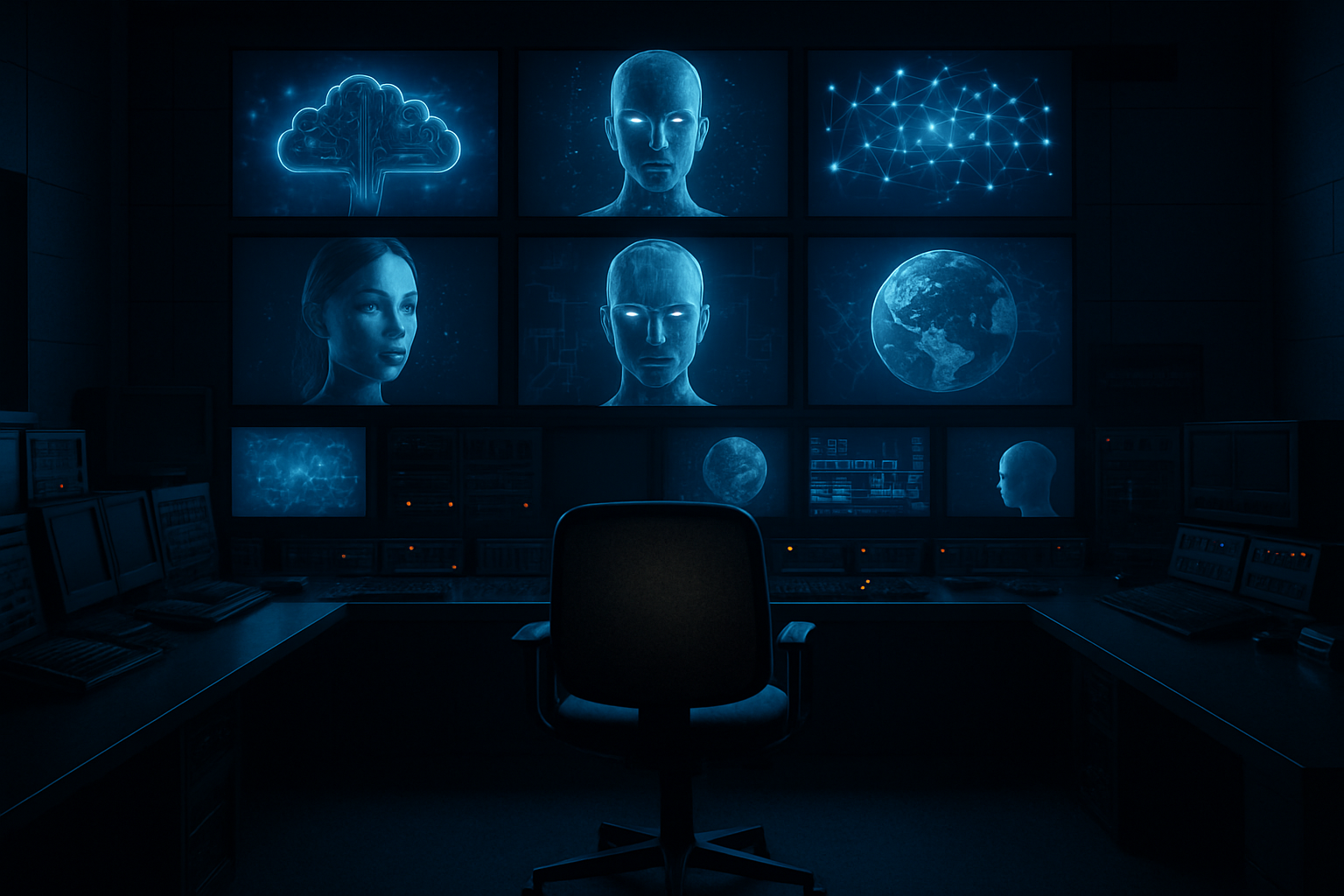
Fairground AI’s generated channel launched to brutal reviews—and that’s beside the point. The real shift is infinite supply hitting fixed demand, and it points straight at a question most of us are ignoring: when the machine does the work, who’s left holding the pen?
On 13 August this year, the first fully generated television channel went live on Roku. Within 48 hours, the internet had christened it ‘AI slop.’ I’ll be honest—my first reaction matched theirs. My second reaction, about a day later, was that arguing over the quality misses the entire story.
The channel is called Fairground AI Creator TV. Every frame is generated. No actors, no crew, no shoot. It looks like a channel, it schedules like a channel, it sells ads like a channel. And yes, if you sit and watch it, the failure modes are exactly what you’d predict: faces that drift between shots, physics that’s nearly right (and therefore worse than obviously wrong), and a total absence of the thing that makes narrative work—a scene built because somebody wanted it to mean something.
But here’s why I don’t want to spend this article on that, and it’s the same reason I wouldn’t have spent one in 1999 explaining that video on the internet looked terrible. Of course it did. The quality of the first version has almost no predictive value. What has predictive value is the cost curve underneath it.
The Economics Are the Story
Free ad-supported television is brutally tight. You make money on advertising against watch hours. The rates are low, so the entire business is a race between the cost of filling 24 hours a day and the revenue those hours can generate. Which is why the free streaming ecosystem is largely built on library content—formats nobody’s licensing at a premium any more, back catalogue, the stuff whose marginal cost of re-airing is close to nothing.
Now watch what generated content does to that equation. It doesn’t lower the cost of content. It removes the floor entirely. No acquisition, no rights window, no residuals, no revert. If your channel costs almost nothing to fill and it earns even a small amount, it’s profitable on day one—and it’s profitable at a scale of one channel or 1,000 channels.
That’s the bit that matters, not the quality. The fact that the supply side has become effectively infinite while the demand side—which is human attention in the evening—has not moved at all.

Infinite supply against fixed demand is not a technology story. It’s a pricing story, and it points in one direction. If the amount of watchable material goes up by orders of magnitude and the number of hours in an evening does not, then the value of any individual hour of content falls. Not the value of the best hour—the value of the average hour. And most of our industry is not in the business of making the best hour. Most of our industry is in the business of reliably making the average one, on schedule, on budget, to a standard. That’s where the employment is.
So the honest read is not that generated content will replace prestige drama. It’s that it competes directly with the enormous middle of the market: the filler, the acquired formats, the daytime, the things that exist because the schedule has to be filled. And that middle is where a very large number of people in this industry actually work.
The Company That Runs Itself
This connects to a claim I heard at an AI summit recently: that within roughly 18 months, we’ll see a genuinely autonomous company. Not a company that uses AI—a company where the agents do the work end to end. They find the customer, they make the thing, they invoice, they handle the support ticket, they file the accounts. No human sits in the loop on any given day. The summit framing is quite specific about the stages: you go from co-pilots (where most organisations actually are) to agents doing bounded tasks, to autonomous workflows that run without a person initiating them. The end state they describe is an organisation chart with nobody on it.
My instinct is that this is the same species of claim as the fully automated newsroom, which has consistently failed to arrive. But the evidence is genuinely split. Task-specific agents went from under 5% adoption last year to a forecast of around 40% by the end of this year. Something close to three-quarters of businesses say they intend to deploy agents inside that window.
Against that: over 40% of agentic AI projects are forecast to be cancelled before the end of next year on cost and on unclear business value. So the picture is not a straight line up. It’s a very large number of organisations starting, and a very large number of them stopping.
But there’s a harder objection than cost. A company is not just a set of tasks. A company is a legal thing. Who signs?
The Wall
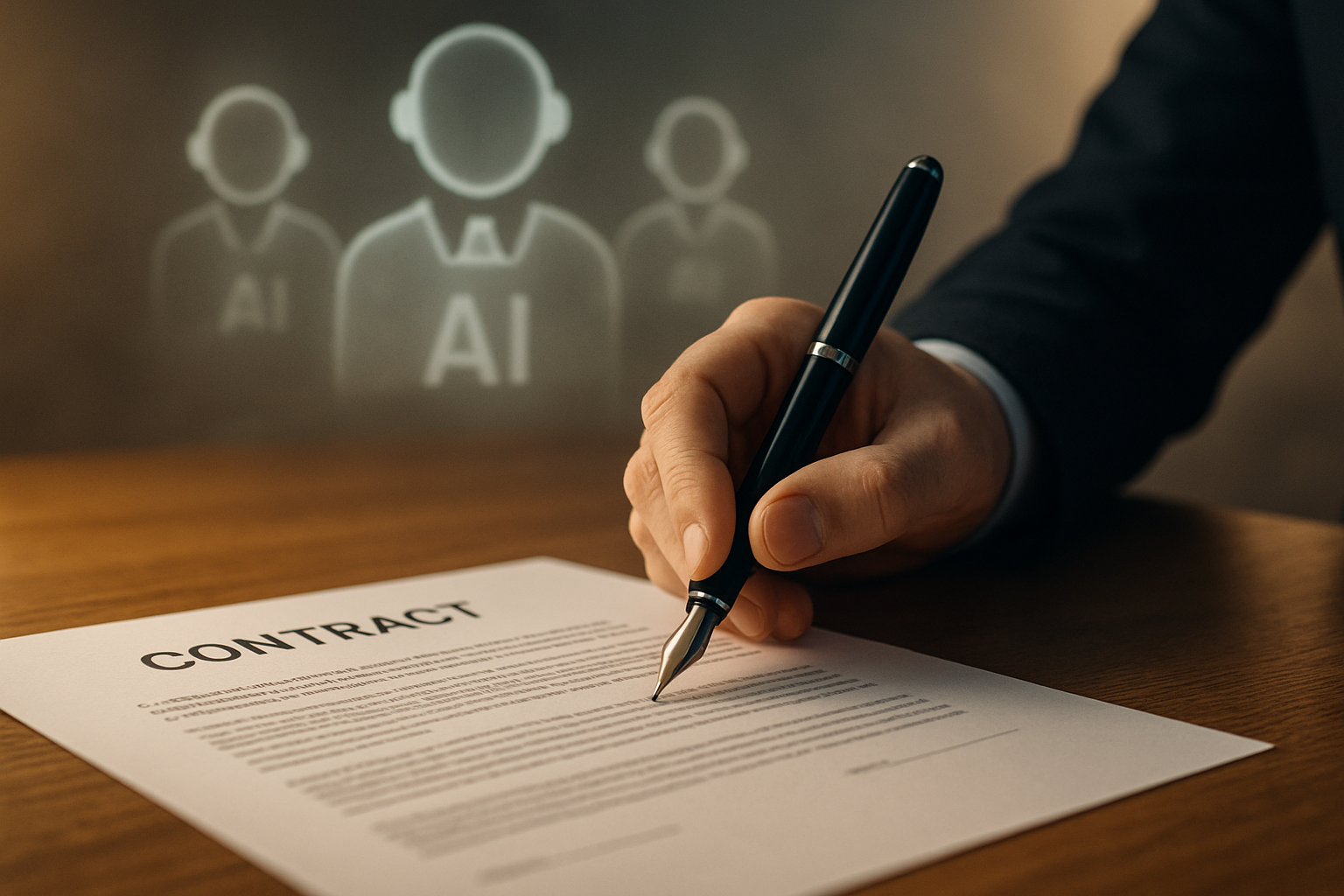
This is the wall, and it’s the most useful thing in this entire conversation. A model can execute the work of a business. It cannot be the business. Legal personhood requires a person or a registered entity. A bank account requires a legal owner. A contract requires a party that can be sued. So every one of these so-called zero-human companies, when you look underneath, is running inside somebody’s limited company with a director, and that director is on the hook.
The machine executes. The human signs.
Which means the 18-month claim, in the form it’s usually made, is not wrong so much as it is misdescribed. What’s arriving is not a company with no humans. It’s a company with one human, whose entire remaining job is accountability.
And that’s our world exactly. A broadcaster is not a set of tasks either—it’s a licence. Somebody holds the licence; that somebody answers for what went out. It doesn’t matter whether a person, a playout automation system, or a generative model put the frames on the air. It doesn’t transfer to a vendor because you bought a tool, and it doesn’t transfer to a model because the model made the choice.
So take that AI-only channel and ask the question that nobody in the coverage asked: if it broadcasts something defamatory, who is liable? Not the model. Not the creator who typed the prompt, probably. The entity that published it—which is a company with directors, with a registered address, sitting behind $4 million of venture funding.
The channel has no people in it. The business absolutely has people on the hook.
What to Actually Do
Somebody running a media operation hears all this on a Monday morning. What do they actually do?
Three things, and none of them are glamorous.
First, be extremely honest about which part of your output is the middle of the market. If a meaningful share of what you make exists to fill a schedule rather than to be sought out, that’s the part exposed to infinite supply, and you should be planning for it now rather than being surprised by it in two years.
Second, stop evaluating this on quality and start evaluating it on cost per hour, because quality is the variable that moves fastest and cost is the one that decides.
Third, and this is the one I’d actually act on this week: write down where accountability sits in every automated process you already run. Not where the technology sits—where the signature sits. Because the organisations that will handle the next three years well are not the ones with the best models. They are the ones that can answer, instantly and in writing, the question of who is responsible when it goes wrong.
That’s the thing the machine cannot take from you, and it’s also the thing that quietly turns out to be the job.
My Honest Prediction
I think we’ll absolutely see a business that operates with no staff and generates real revenue, and I think it will happen sooner than 18 months, because in a narrow enough niche it has arguably happened already. What we won’t see is a company without a person who answers for it, because that’s not a technology problem—it’s a law problem, and the law is not moving at the speed of the models.
So the channel with nobody in it still has somebody behind it. It always did. And the question worth asking, about any of this, in our industry or anyone else’s, is not what the machine can now do. It’s who’s standing there when it gets it wrong.
Ancast Intelligence — AI in broadcast consulting by Ben Anchor.