
I’ve Spent a Year Watching AI Quietly Become Plumbing — and Nobody Noticed

The revolution didn’t arrive in the keynote. It turned up in the machine room at 3am, wearing high-vis, doing the work nobody wanted to film for the sizzle reel.
There’s a particular kind of dishonesty that happens at trade shows. Not the obvious kind — the vaporware, the renders that will never compile — but the subtler lie of emphasis. The thing on the stand is always the thing that hasn’t shipped. The thing that has shipped is running in a server room in Salford at half past two in the morning, and nobody’s written a press release about it.
I recorded an episode this week on AI use cases that actually made it into production, and what struck me most wasn’t the technology. It was the gap between what we talk about and what we’re actually running. So let me pull that apart, because I think the gap tells you more about this industry than the demos ever will.
The Stuff That Worked Was Boring
Here’s the list of AI deployments that are genuinely load-bearing in broadcast workflows right now: metadata tagging, subtitling and localisation, compliance flagging. That’s it. Not synthetic anchors. Not fully automated newsrooms. The three things that work are the three things nobody put in a keynote.
And I find that split genuinely funny, because it’s the exact inverse of the coverage. The stuff that got the headlines didn’t ship. The stuff nobody wrote about is running unattended in the middle of the night, processing yesterday’s rushes while the building’s empty.
Let’s take metadata first, because this is where I’ve spent a chunk of my career and I have opinions. The pitch is real: point a model at an archive, get speech-to-text, face recognition, object detection, shot classification, searchable transcripts. Work that used to take a cataloguing team months becomes a processing job measured in days. I’ve watched teams find material in an afternoon that they’d written off as unfindable — which in practice had meant re-shooting something they already owned.

But here’s the part the demo never covers. Performance depends far less on the model than on the state of the data you point it at. Every media asset management project I’ve ever worked on had the same archaeology: metadata from the tape era, metadata from the first digital migration, metadata from the system you bought in 2014, three different naming conventions from three people who’ve all since left. Point a clever model at that mess and you don’t get intelligence. You get confident nonsense at scale. And you get it faster than you can check it.
Which brings me to the thing that bothers me most about auto-tagging: a tag is a promise. If the machine tags a clip as a particular politician and it’s wrong, and somebody pulls that clip for a news package on deadline, the mistake doesn’t stay in the database. It goes on air. Where’s the safety net?
The answer is that the safety net has to be structural, not optimistic. Two things matter. First: precision matters far more than recall in our industry, and most vendors sell you recall. Recall is how much of the relevant material the system finds. Precision is how much of what it finds is actually right. A tool that finds 90% of everything but is wrong one time in ten is a disaster in a newsroom. A tool that finds 60% and is essentially never wrong is a gift. Ask for precision figures. Ask on your content, not their demo reel.
Second: insist on confidence scores being exposed in the interface. There’s an enormous operational difference between a system that says “this is definitely him” and one that says “I’m 70% sure this is him”. The second lets a journalist make a decision. The first invites them to skip one.
Compliance: The One I’d Have Bet Against
Compliance is not a technical judgement — it’s a regulatory one. I’d have bet against any broadcaster telling a regulator “the machine cleared it”. And you’d be right that no broadcaster would ever say that out loud. But compliance is nonetheless one of the three genuinely mature use cases, and it’s worth understanding why.
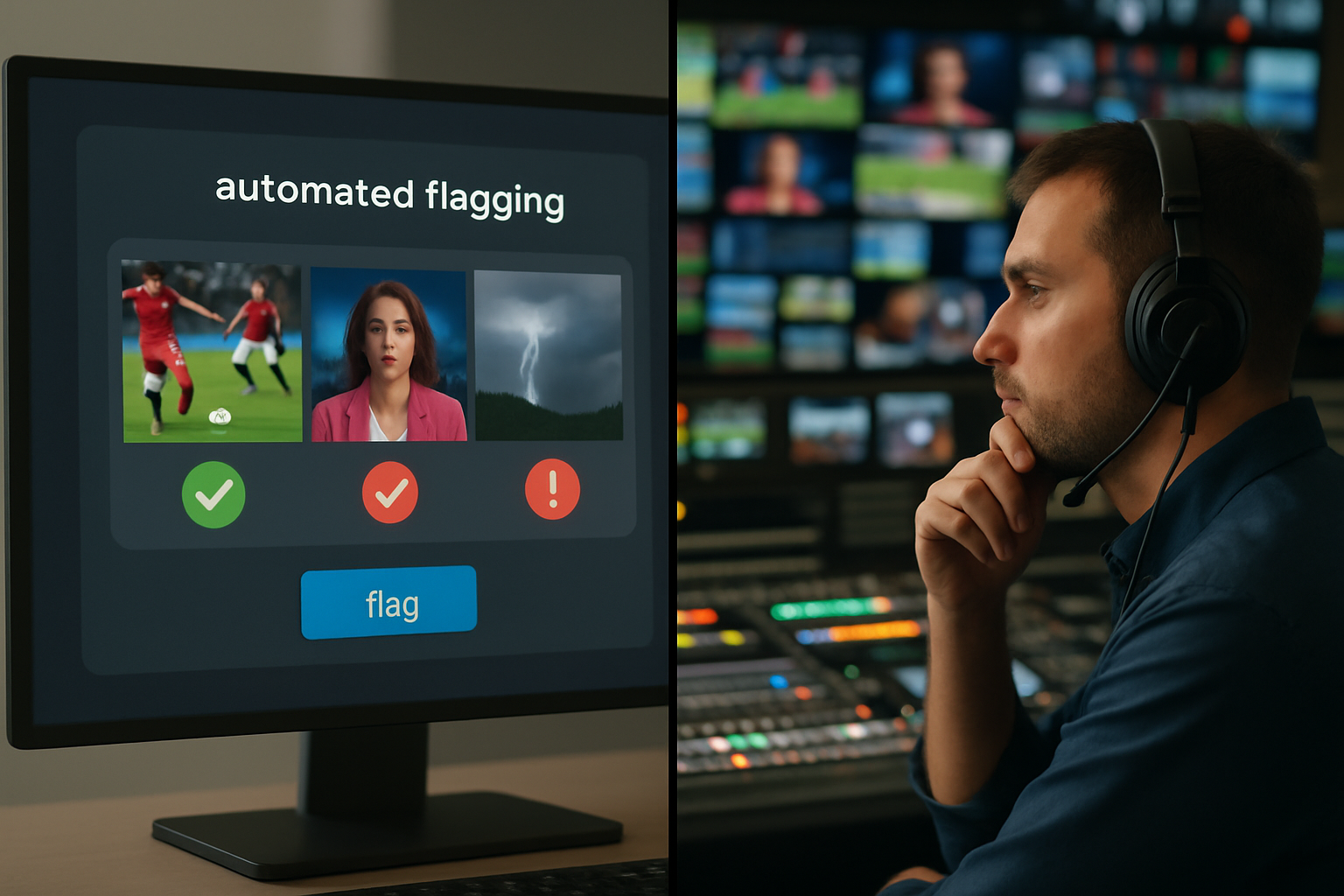
What’s actually been deployed isn’t automated judgement. It’s automated triage. Systems scan output and flag candidates: strong language, brand prominence, flashing imagery, product placement, watershed breaches, sensitive material. What that does is invert the economics of compliance viewing. Historically, a compliance viewer watched everything to find the small percentage of things that mattered. The cost scaled linearly with volume, which in a world of multiple channels and streaming variants became unaffordable.
The machine now watches everything. The human watches the flags. And I want to be precise about the boundary, because this is where I’ve seen people get careless. The flag is a candidate. The judgement is a person. And critically, the accountability is neither of them. The accountability sits with the licence holder, always. It doesn’t transfer to a vendor because you bought a tool. If a regulator comes to you about a breach, no procurement contract in the world will make that somebody else’s problem.
The Question Nobody Puts in a Press Release
So let me answer the thing everybody in this industry is actually asking: is this augmentation, or is it headcount?
It’s both. And pretending otherwise insults the audience. When one pipeline replaces nine editors with two operators, that’s not augmentation for the seven. But here’s something more useful than a slogan: there’s a pattern to which jobs have gone and which haven’t, and it’s remarkably consistent.
Look at every deployment that’s actually succeeded and you’ll find three shared characteristics. One: the task was high-volume and repetitive. Two: the failure mode was cheap and obvious — a wrong tag or a bad subtitle gets caught and corrected without anybody dying or being sued. Three, and this is the one everybody misses: there was already a human sign-off gate in the process before the technology arrived. Compliance had a viewer. Localisation had a reviewer. Post had an editor approving the cut. The machine slotted in underneath an existing checkpoint.
Now look at the ones that stalled — the anchors, the automated newsrooms. Same volume argument, same efficiency case, but no pre-existing gate, because nobody had ever needed to approve a presenter’s face. The deployments that worked weren’t the ones with the best technology. They were the ones that landed in a workflow that already knew how to say no.
What You Actually Do on Monday Morning
Five things, and I mean this tactically, not strategically.
One: pick your first use case by looking for that existing sign-off gate, not by looking for the biggest saving. The gate is what makes the savings survivable.
Two: fix your taxonomy and your rights metadata before you buy anything. You cannot automate your way out of a data problem. You’ll simply industrialise the mess.
Three: test on your own content, with your own edge cases. Treat any vendor benchmark as marketing.
Four: demand confidence scores in the user interface. The whole model depends on humans knowing when to look harder.
Five: write down where accountability sits before the first pilot, not after the first incident. Make sure everyone in the chain can name the person, not the system.
The most consequential AI in broadcast this year didn’t present a bulletin, didn’t write a script, didn’t appear on a stand. It tagged the rushes, wrote the subtitles, flagged the strong language. It’s dull, it’s deeply useful, and it’s already load-bearing. The revolution turned up in the machine room, wearing high-vis, and everyone was looking at the stage.
Ancast Intelligence — AI in broadcast consulting by Ben Anchor.