
Stop Buying AI. Start Building It.
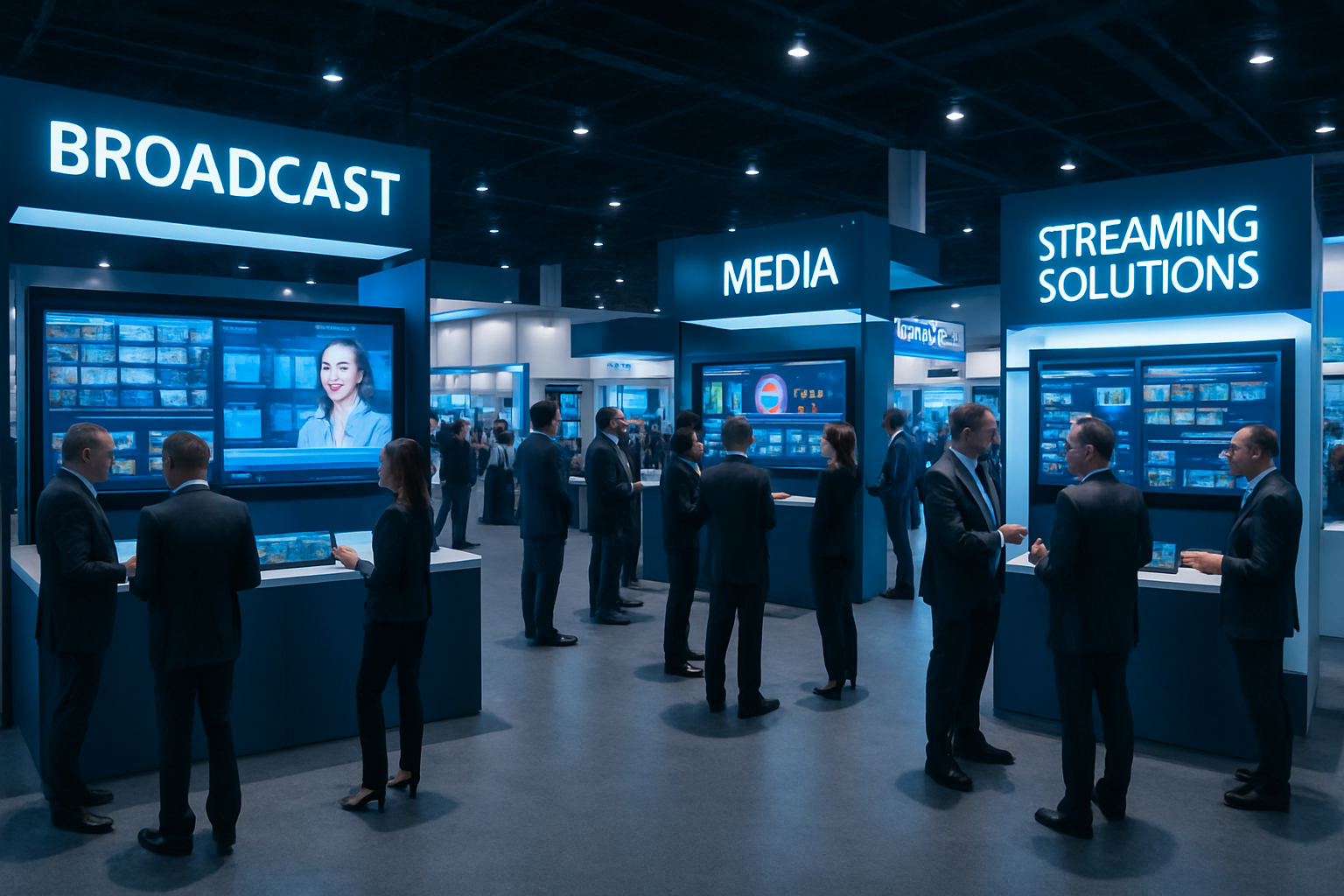
Before I left for MPTS, I decided to ask every broadcaster I met one question: What model have you built? The answers told me everything about where broadcast AI really stands in 2026.
There’s a version of this conversation where I turn up at MPTS with a spreadsheet, tick off vendor demos, and write up a neat taxonomy of who’s doing what in broadcast AI. That version would be polite, comprehensive, and almost entirely useless.
So I’m not doing that. Instead, I’m walking into Olympia this morning with one question for every broadcaster, every CTO, every exec who tells me they’re “doing AI”: What have you built?
Not what are you using. Not who’s your vendor. What model do you own? What data science have you developed in-house? What piece of intellectual property sits inside your organisation that isn’t leased from a third party?
I recorded this episode with Raiana before I left, and the conversation clarified something I’ve been circling for months: we are deep in the trough of disillusionment. Three years into the broadcast AI cycle, most organisations have trialled six tools, deployed two, and can’t point to a single thing they actually built. The models belong to vendors. The training data flows out. The competitive advantage, if it ever existed, sits somewhere in a SaaS contract.
That’s not an AI strategy. That’s procurement.
Wrapper AI vs Bespoke Models
Let me be precise about what I mean by bespoke, because the term gets thrown around carelessly.
A bespoke model is one of three things:
- A model trained end-to-end on your own proprietary data.
- An existing model fine-tuned so heavily on your data and your domain that the output is materially different from the base model.
- A custom orchestration layer where multiple specialised models work together to solve a problem unique to your business.
Everything else — the co-pilot licences, the bolt-on workflow accelerators, the vendor APIs with a thin customisation layer — that’s what I call wrapper AI. You write a prompt, the vendor gets your money, your staff get a slightly faster tool, and your competitive position stays exactly where it was six months ago. Because so does everyone else’s.
Wrapper AI isn’t bad. It’s just not strategic. And if you’re a broadcaster trying to navigate the next five years of audience fragmentation, content economics, and platform competition, you need something more durable than a faster button.

Why Nowcasting Has to Be Bespoke
This is where my own work becomes relevant, and I want to be clear about why.
Nowcasting — the kind of real-time predictive intelligence I’m building with the UC Berkeley team — takes signals like Google Trends data, weather, social sentiment, audience measurement logs, CDN delivery patterns, and channel flow, and uses them to predict content performance in near real-time. It’s forecasting, but at a fraction of the time horizon and a fraction of the noise.
Why does that have to be bespoke? Because the signals are broadcast-specific. A generic forecasting tool doesn’t know that a heatwave shifts audiences off live linear and onto on-demand. It doesn’t know that a major football fixture cannibalises news viewership for 90 minutes. It doesn’t know that BARB data lags and CDN logs lead. The intelligence that matters is in the relationships between these signals, and those relationships only become visible when you build the model on your own data, for your own audience.
You can’t buy that off the shelf. You can only build it.
The Diagnostic Question
So when I’m on the show floor tomorrow, I’m looking for evidence that broadcasters have moved past wrapper AI into model ownership. And the diagnostic is simple: if I ask you what model your organisation has built, does the conversation get specific or does it dissolve into vendor names?
The vendor name is the tell. If your first response is the name of a tool, you haven’t built anything. If your first response is the name of a problem you have a model for, you’re building.
I have hypotheses about who I’ll hear about. The BBC’s R&D team will come up — they’ve been doing original model work for years. Sky has the scale and the data. ITV has the audience science discipline. Sports broadcasters are further along because the use cases are clean and the commercial pressure is immediate. DAZN has done serious work.

The wild card? FAST operators. They have the right data shape for nowcasting because their schedules are software. But most of them are still under-resourced on data science. That gap — strongest commercial pull, weakest current capability — is exactly where Ancast Intelligence is positioned.
What Success Looks Like
If I come back from MPTS having heard the same five vendor names from 20 different executives and not a single example of a broadcaster developing a bespoke model for a problem their own business cares about, that’s a failure. It would tell me the industry is still where it was 18 months ago: buying capability, not building it.
Success looks like three or four specific examples: named broadcasters, named problems, named data science teams. People I can have follow-up conversations with. A mental shift from who’s your vendor? to what have you built?
And if you’re reading this and you work in broadcast, ask the same question in your own organisation this week. Not what tools are we using? but what models do we own? The answer will tell you more about your AI strategy in five minutes than any vendor pitch will tell you in five hours.
I’ll be back in two weeks with the field report. Let’s see who’s building.
Ancast Intelligence — AI in broadcast consulting by Ben Anchor.